Kinoxi · camera-free workwear · job blueprints for physical work
Map physical work, task by task — what to make safer for people, what to hand to robots.
Worn through a shift, our workwear turns the work into a job blueprint: every step, the load it puts on the body, and whether a robot could take it over. No camera, no microphone, and the employer never sees one person’s numbers.
Pilots openOne job, one workstation
[ The problem ]
Nobody has a map of the job.
A picker lifts a box from a low pallet, turns, carries it and sets it on a shelf at shoulder height, hundreds of times a shift.
The safety lead knows lifting is risky, but not which task is worst. Operations wants to change the station, but which change first? A robot team wants to take the job on, but nobody has written down what it really involves, step by step.
Today all three judge the job from a short observation or a checklist, which misses most of the shift.
They all need the same answer: a map of the job, step by step. Kinoxi measures it on the body, across whole shifts, by task.
[ Why a site pays for the map ]
One map. The decisions a site already pays to get right.
- Fix the worst task first. Tasks ranked by measured load on the body, so the redesign budget goes where it counts. Measure again after the change to see whether it worked.
- Rest the assessment on measurement. The physical-workload assessment a site already has to write, built on whole shifts scored against published standards (ISO 11226, EN 1005-4, REBA), not a short observation.
- Plan where robots fit. Each job split into timed steps and checked against published robot limits, such as payload and reach: a ranked list of what to hand to robots first, from the same recording.
- Make hard jobs easier to keep. Fixing the hardest tasks, with a system that cannot single anyone out, helps people stay in physical jobs.
Who it is for
Operations, EHS and automation leaders at sites where people lift, carry and handle all shift.
Where it starts
One job at one workstation, typically lifting, carrying and placing.
Industrial partners: choose one job and sponsor a scoped pilot.
[ The job blueprint ]
Every job, step by step. What to make safer, what to hand to robots.
A shift becomes a blueprint: the job split into timed steps, each with the load it puts on the body and the robot limits it would hit, such as payload or reach. Safety gets a fix list; operations and robot teams get an automate list. Same recording, same map.
The job, step by step
| Step | Load on the body | Next move |
|---|---|---|
| Bend to the low pallet | HighBack, knees | Make saferRaise the pallet |
| Lift the box | HighBack | Make saferBeyond the robot’s payload: add a lift aid |
| Turn and carry | MediumBack | Hand to a robotWithin payload and reach |
| Place at shoulder height | HighShoulders | Hand to a robotWithin reach at shelf height |
| Check and label | LowArms | Keep with peopleFine hand work |
| Night shift | Not shown: fewer than five workers | |
One change, measured again
Bend to the low pallet after raising the pallet
- BackHightoMedium
- KneesHightoLow
Before and after, against the baseline the pilot measured first.
[ Robot deployment ]
The same map shows which tasks to hand to robots.
Which tasks to hand over
Blueprints rank each step by its load on people and by the robot limits it would hit, such as payload or reach. The list of tasks that load people most is also the list worth automating first.
Where robots fit
Station by station: which steps a robot could take over, which stay with people, and what to redesign around them.
What the work really looks like
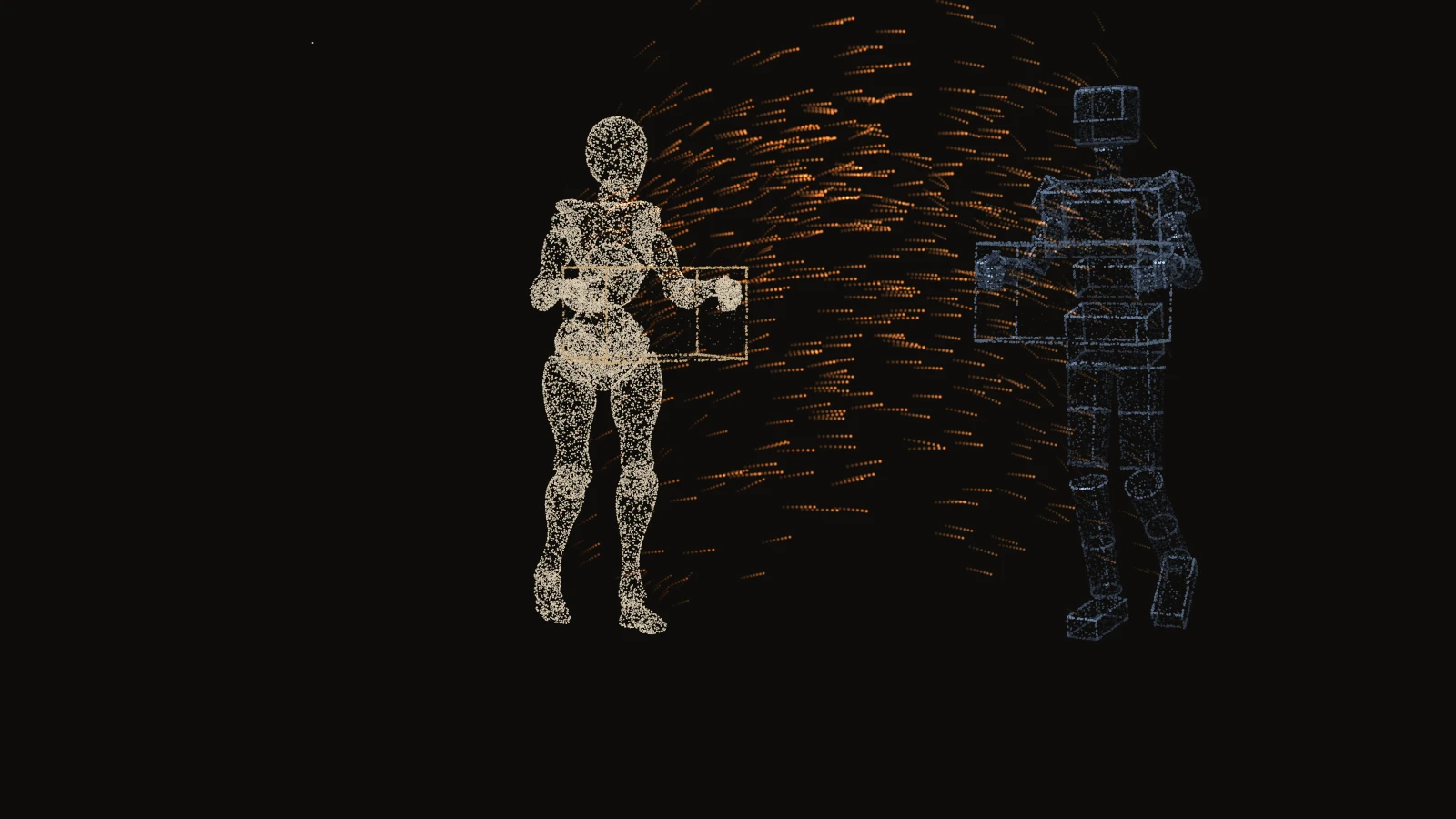
Whole-body motion of the real job, measured on the body, pooled into timed steps by task and team. Robot teams get the task spec, never one worker’s readings.
Building robots for physical work? We work with robotics teams who want to know which jobs to take on, and what those jobs really involve. For robotics teams
On the roadmap: a separate, voluntary camera capture kit for labs and partners, never part of the everyday workwear.
[ How it works ]
Wear it for a shift. Get a map of the job.
- Wear. Workers who choose to take part wear the workwear through a normal shift. It is designed for the whole body: legs, trunk and arms.
- Measure. The workwear measures how the body bends, lifts, reaches and carries, relative to the body itself. The everyday workwear has no camera, no microphone and no GPS.
- Anonymise. Readings are separated from names and pooled by task and team. A group of fewer than five workers is held back.
- Map. Each job becomes a blueprint: timed steps, the load of each on the body, and which steps are worth redesigning or automating. Measure again after a change to see whether it helped.
Design principle: we map the job, not the person. The employer sees tasks and teams, never one person’s numbers.
[ How a pilot works ]
One job. A fixed number of weeks. A blueprint at the end.
- Choose one job at one workstation, typically lifting, carrying and placing.
- Agree the scope, the number of weeks, the consent process and the reporting with site leadership, workers and the works council.
- Map it: the first job blueprint, step by step, with the load each step puts on the body and which steps are worth automating.
- Make one change, then measure again: a before-and-after blueprint against the baseline.
What you receive
A job blueprint and a before-and-after, at team level, like the example above.
The decision it supports
What to redesign first, what to automate, and whether the change worked.
Industrial partners: choose one job and sponsor a scoped pilot.
[ Built for European workplaces ]
Privacy is the design, not a setting
Data minimisation by design
The garment measures the angles between body parts. With no camera, no microphone and no GPS on the everyday workwear, there is no image, voice or location to protect.
Team-level reporting
The employer sees tasks and teams of five or more workers. A smaller group is not shown, and nobody receives an individual score.
Worker consent
Workers choose to take part, and consent is agreed before the first shift, not after the first report.
A pilot pack for your works council
For each pilot we prepare a pack your works council can review, and the input for your data-protection impact assessment (DPIA): what is measured, what is reported, who sees it and how long it is kept.
These are the principles we build to and what we bring to a pilot. They are not a certification: your works council and your legal advisers have the final word.
[ FAQ ]
Is it surveillance?
No. We map the job, not the person. The everyday workwear has no camera, no microphone and no GPS. Workers choose to take part, and managers see tasks and teams, never individuals.
Can my manager see me?
No. Managers see teams of five or more workers, never one person. A smaller group is not shown at all. That floor is built into the reporting software, not left to a setting.
Is this performance monitoring?
No. The job blueprint describes the work: the steps of each task and the load they put on the body. It holds no individual scores, no speed or productivity figures and no location.
Does the works council need to agree?
In many European workplaces, yes, and we plan for it. For a pilot we prepare a pack for your works council and the input for your data-protection impact assessment: what is measured, what is reported, who sees it and how long it is kept. Your works council and your legal advisers have the final word.
Where is the data kept?
Where readings are stored, who can reach them and how long they are kept are set out in the written pilot agreement, before the first shift. The readings carry no video, no audio and no location, and the employer’s blueprint holds team-level results only.
How does it work?
Workers who choose to take part wear the workwear through the shift. It measures posture and movement relative to the body. The readings are anonymised and pooled by task and team, and the employer receives a job blueprint: each task split into steps, with the load each step puts on the body and which steps are worth automating.
Who is it for?
Operations, EHS and automation leaders who want to know which tasks to make safer and which to automate, from measured work rather than a short observation. We are looking for industrial partners to map one job in a scoped pilot.
Team
We map physical work, task by task, so employers know what to make safer for people and what to hand to robots.
Gergana Dragoeva
Co-founder & CEO
Product and business development background; direct industrial relationships.
Prakash Acharya
Co-founder & CTO
Leads sensor and technical development.
[ Contact ]
Work with us
Industrial partners: choose one job and sponsor a scoped pilot.
Investors: help us map physical work, job by job.
Robotics teams: find out which tasks to hand to robots, and what the work really looks like.
Write to hello@kinoxi.tech.
[ Sent ]
Thank you. Your message reached the founders, and we will reply by email.